
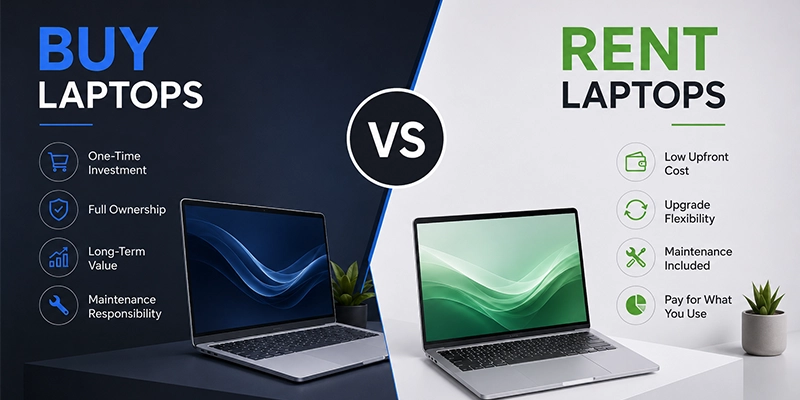
Buy vs. Rent Laptops: Which Is Better for Businesses, Students, and Events?
Choosing between buying and renting a laptop looks simple until you consider how the device will actually be used. A business may need 50 laptops for a new project, a student may need one for a semester, while an event organiser might need hundreds for only a few days. In each case, the better option can be different.
The right decision is less about which model costs less today and more about how long you need the laptop, what you need it to do, and what happens after you stop using it.
When Buying a Laptop Makes More Sense
Buying is usually the straightforward choice when a laptop is going to be used regularly for several years. A business with stable employees and predictable hardware requirements may benefit from owning its devices. Once purchased, the organization has control over the equipment and can decide when to upgrade, transfer or sell it.
Ownership can also make sense for students who expect to use the same laptop throughout university and beyond. Instead of making recurring rental payments, they have an asset they can continue using after graduation.
However, the purchase price is only part of the cost. Businesses also need to consider warranties, repairs, battery replacement, IT support, depreciation, and eventual disposal. Laptop batteries naturally lose capacity with charging cycles and age, so long-term ownership can involve maintenance as the device gets older.
When Renting Becomes the Practical Choice
Laptop rental becomes particularly useful when the requirement is temporary, uncertain or likely to change.
For businesses, this could include a short-term project, seasonal hiring, training programme, temporary office or additional equipment for contractors. Renting avoids a large upfront hardware purchase and can help preserve working capital. Industry guidance and recent Indian business discussions also highlight easier replacement and reduced procurement and maintenance responsibilities as potential advantages of IT equipment rental.
Events are another strong example. A conference, examination, workshop or corporate training programme may require dozens or hundreds of laptops for a limited period. Purchasing that equipment can leave an organisation with a large fleet that it no longer needs once the event ends. Renting allows the requirement to match the actual duration of the project.
What About Students
For students, the decision largely depends on duration and budget. If the laptop will be used every day for several years, buying may offer better long-term value. If it is needed only for a short course, internship, project, or temporary academic requirement, renting can avoid committing to an expensive device.
Students should also consider their workload. Basic coursework may require modest specifications, while engineering, architecture, design, coding or video-production courses can demand more capable hardware. Renting can make it easier to access a higher-specification machine for a defined period without purchasing it outright.
The Real Cost: Look Beyond the Price Tag
Businesses should compare total cost of ownership, not simply the purchase price, against the total rental payments. For a purchased laptop, this can include the original cost, warranty extensions, repairs, maintenance, IT administration, replacement devices, depreciation and residual value. With rental, the important questions are different:
- What is included in the rental fee?
- Is technical support available?
- What happens if a device develops a fault?
- Are replacement units provided?
- What are the terms for extending or ending the rental?
The answers can vary considerably between providers, so the contract should be reviewed carefully before making a decision. Software support is another consideration. Microsoft maintains defined servicing lifecycles for Windows products, and businesses should ensure their chosen hardware remains compatible with supported operating-system versions.
So, Which Option Is Better?
There is no universal winner.
Buying is generally better when:
- The laptop will be used for several years.
- The workforce or user requirement is stable.
- The organisation wants ownership.
- The business has the budget and resources to manage the hardware lifecycle.
Renting is generally better when::
- Equipment is required for a limited period.
- The number of users may change.
- A project or event needs temporary devices.
- The organisation wants to avoid a large upfront purchase.
- Quick replacement or technology changes are important.
For many organisations, the smartest approach may actually be a combination of both. Permanent employees can use company-owned machines, while temporary staff, events and short-term projects are supported through rental.
Conclusion
The best choice starts with a simple question: What is the laptop needed for, and for how long?
Once those two factors are clear, compare the full costs, support requirements and flexibility offered by each option. For businesses and event organisers that need dependable equipment without committing to long-term ownership, A1 IT Rental can be considered as part of that evaluation.
Ultimately, buying gives you ownership, while renting gives you flexibility. The better option is the one that fits the way you actually use technology.
Empowering IT Businesses One Step at a Time
transforma Support team tiveinvolve asseyour current ancial gize grantsbvisualize strategic ediarey.